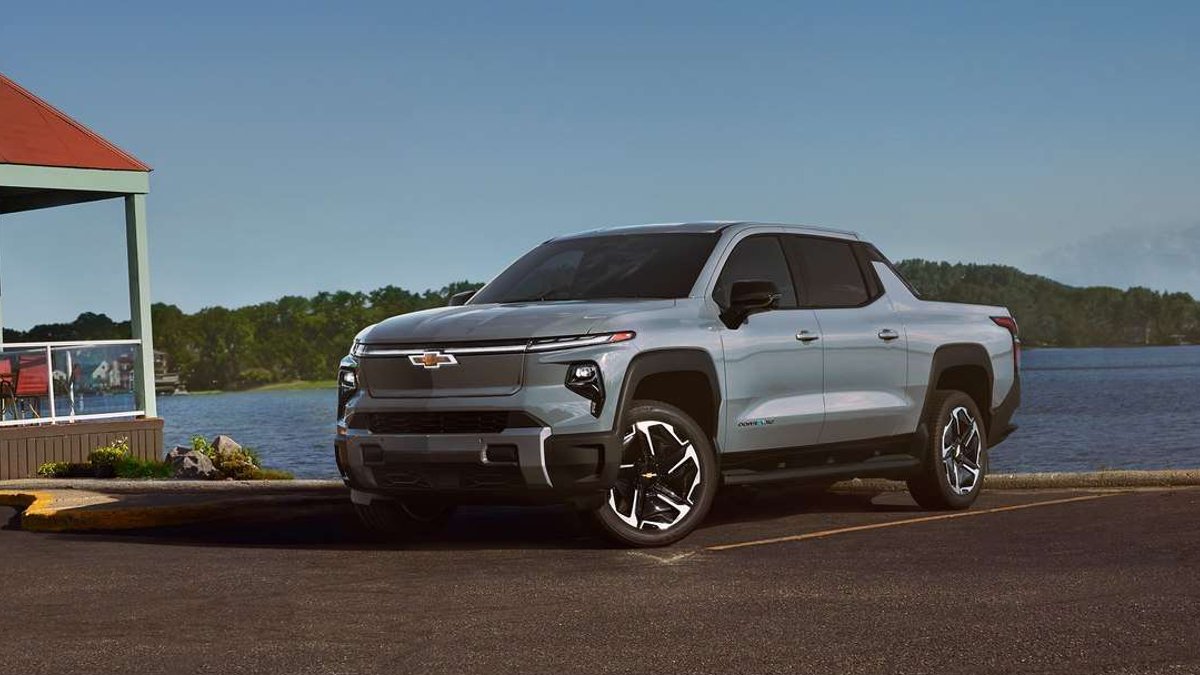
A Chevrolet Silverado EV owner reported unhitching his Airstream nine times in three days during a move from Joshua Tree, California, to Olympia, Washington. He had to park his trailer, drive to a charging station, and then return to reconnect everything.
“I travel within the Airstream full time, so wherever I go — it goes,” he wrote.
He had previously towed the same Airstream with a 2020 Ford F-150 5.0-liter V8 and a 2022 Silverado 2500 diesel. “It felt as good as the 2500 diesel, and leagues better than the F-150,” he wrote.
Charging Networks Should Prioritize Long-Trailer Access
Only two of his 11 charging stops allowed him to remain hitched. Charging networks for electric pickups should ensure long-trailer access is a basic feature. They should also inform drivers about the number of stalls that can accommodate their rigs. A site’s total charger count often hides the limited options available for towing customers.
An available charger doesn’t always mean a suitable stop. His 52-foot truck-and-trailer combination required ample space to maneuver, reach the cable, and exit. A functioning plug is only part of the solution.
Tesla’s Cybertruck owner’s manual defines a trailer-friendly Supercharger location as one where a trailer can remain attached, but it doesn’t guarantee every stall meets this criterion.
Rivian’s published description of its Southampton, New York, outpost mentions six fast chargers, including one trailer-friendly pull-through. This illustrates the distinction: if the pull-through is occupied, the other five chargers do not create a second advertised pull-through.
A Sierra EV driver towing a 30-foot camper reported two pull-throughs at a 100-stall Tesla site. A large charging plaza can still leave towing drivers competing for a small subset of its spaces.
Tesla already describes 3D site maps with live stall availability at selected Superchargers. Networks should make trailer clearance and layout equally easy to establish before a driver arrives.
Queue Position Doesn’t Guarantee Trailer Space
Tesla’s current Waitlist guidance exposes another distinction. At selected sites, its virtual queue tells drivers when they can charge, but it does not assign a specific stall. Drivers choose an available Supercharger when their turn arrives.
If the open stall requires unhitching while the pull-through remains occupied, a place in the queue has not solved the trailer problem. This is a question for the network’s current design; the owner’s account does not establish that he used Waitlist.
A queue serving towing customers should account for the stalls they can use while hitched. Showing which suitable stalls are occupied would give the driver something more useful than a reassuring number of open plugs. Networks should make that distinction clear before a towing driver joins the line.
Related Post: Cybertruck Hauls Drumline Gear, Completes 103-Mile Trip
Pull-through charging is already possible. Pilot, GM, and EVgo’s September 2025 network announcement describes stalls designed for vehicles towing trailers. A Sierra EV owner towing a 6,000-pound boat reported staying hitched at a Pilot charger. These examples make dependable trailer access a reasonable expectation.
Retrofitting a confined parking lot may be harder than building a pull-through from scratch. Where a site cannot accommodate a long combination, its listing should say so plainly.
A different route might have avoided some unhitchings; the record cannot establish how many. That limits the blame that can be assigned to a particular location. It does not make nine disconnects a reasonable default for someone moving a 52-foot rig.
A commenter in the same Reddit discussion offered a useful counterexample: a 2025 Denali EV towing a 27-foot Airstream had completed trips of about 1,000 and 800 miles without unhitching.
Fewer Stops Can Limit Options
His roughly 111-mile average between charging stops was a choice. He said he could comfortably travel 150 to 160 miles between charges and was cautious on his first long tow. Treating 111 miles as the truck’s towing limit would turn his reserve into a vehicle defect.
That reserve mattered when he reached a nonfunctional Electrify America charger at a Walmart and had to reroute. Battery left at a broken charger buys another attempt somewhere else. A Cybertruck owner likewise chose chargers no more than 100 miles apart on her first camper tow.
Reevaluating Fuel-Savings Claims
His comparison with his previous trucks is less straightforward. Those gasoline and diesel costs used estimates of his past towing MPG and regional average fuel prices, rather than matching fuel receipts from the same journey.
One subtraction also needs correcting. He listed an estimated $559.25 gasoline bill for the F-150 and said the EV saved $236. Subtracting his stated $362.92 charging spend gives $196.33.
Even those corrected differences remain estimates. He started with a full battery, and the post does not reconcile that starting energy with the battery remaining at the destination.
Planning and Energy Considerations
A 12-mile detour consumes about 10 kWh at his reported 1.2 miles per kWh, before charging losses. This gives a pull-through detour a measurable energy cost to weigh against another disconnect.
A 150-mile leg can require 25 kWh more than the trip average suggests. His log includes 1.0 mile per kWh: at this rate, 150 miles takes 150 kWh, compared to 125 kWh at 1.2. Planning based solely on the average would overlook this difference.
Expectations for Towing Customers
A useful trailer listing should specify the suitable stall, the maximum verified combination length, and the approach and exit path. It should also indicate whether the stall is operational and occupied. A photograph helps, but drivers shouldn’t have to infer whether 52 feet will fit from an image taken at an unknown angle.


