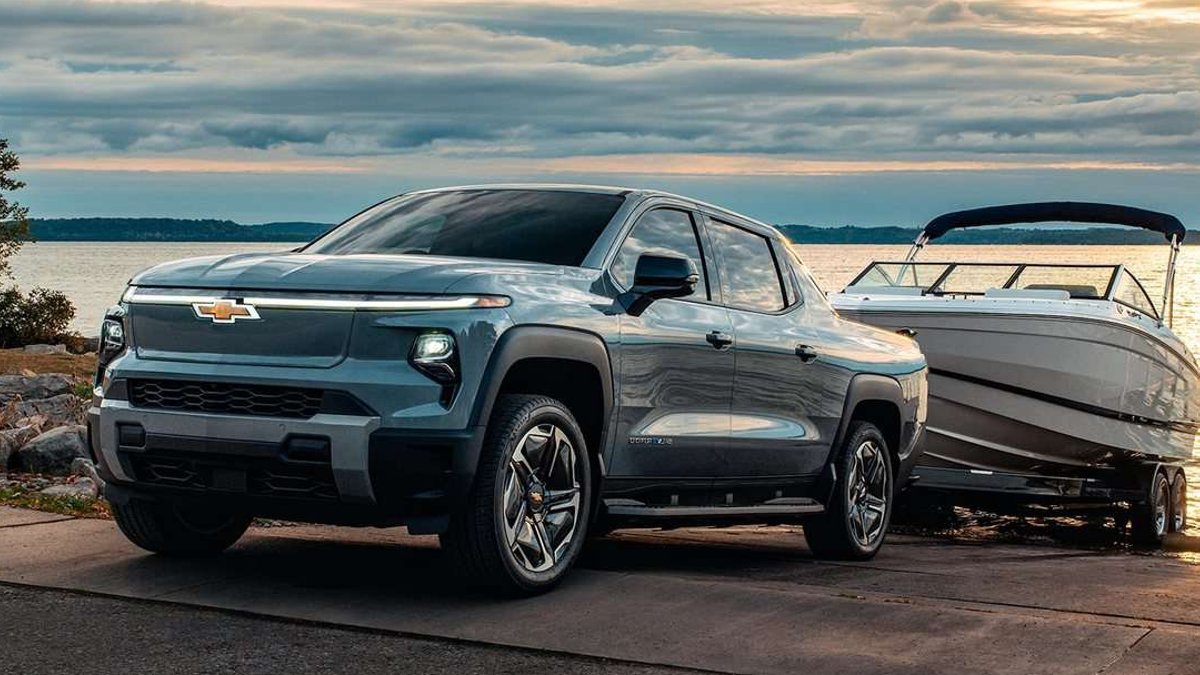
A Reddit user who purchased a 2026 Chevrolet Silverado EV last year declared it the best truck he has ever owned after completing a cross-country tow of a camper over 2,500 miles. His journey, documented in a series of posts, demonstrated how an electric pickup performs under real-world conditions, from highway efficiency to handling charging stops along the way.
The owner, DavidB1420, had originally intended to buy a used Chevy Bolt and trade in his newer Ford F-150 EcoBoost for a smaller vehicle. However, at the dealership, he encountered the Silverado EV and changed his plans. After negotiating for the Bolt, he instead inquired about trading his Ford for the electric truck. He ultimately drove away with the Silverado EV LT Extended Range, which he affectionately dubbed the “Grey Goblin.”
Seven days into the trip, while towing a 20-foot R-Pod 180 camper loaded to approximately 4,500 pounds, DavidB1420 shared an update. The truck’s handling felt remarkably smooth, with minimal trailer sway during acceleration, though he still applied gentle pressure to prevent cargo from shifting. The true challenge, however, centered on battery performance.
On back roads, the Silverado EV averaged 1.7 miles per kilowatt-hour early in the journey. By the midpoint, that figure had improved slightly to 1.6 mi/kWh on mixed terrain. However, on a 450-mile stretch traveled at 70 mph on the interstate, efficiency dropped sharply to 1.2 mi/kWh. The best efficiency reading, 2.7 mi/kWh, occurred on light roads without the trailer attached.
Electric trucks lose efficiency under load
Owners of other electric trucks have reported comparable efficiency losses. A GMC Sierra EV towing a 5,500-pound camper in mountainous terrain recorded 1.2 to 1.3 mi/kWh, while a Cybertruck hauling a boat found that higher speeds sometimes negated time savings from reduced charging stops.
For DavidB1420, these figures required careful planning. A 150-mile leg at 1.2 mi/kWh demanded roughly 125 kWh before accounting for a battery reserve, compared to 94 kWh at 1.6 mi/kWh. The difference could force an additional charging stop—or necessitate a detour.
Navigation relied on the truck’s built-in Google Maps and the third-party app A Better Route Planner (ABRP), both of which helped avoid highways and map charging stops. Neither system, however, handled a GPS failure well. When the truck lost signal and the system failed to recognize movement, both apps froze. Restarting resolved the issue, but the incident exposed a dependency on real-time data.
Google Maps had an advantage, DavidB1420 noted, as it pulled live performance updates directly from the truck. ABRP, while precise for route planning, occasionally lagged. Some Silverado EV owners combine the two, checking PlugShare for charger availability before finalizing a route, while others use ABRP for planning but switch to Google Maps during navigation.
Charging challenges and workarounds
A useful built-in feature streamlined charging: the truck’s navigation could trigger battery preconditioning at planned fast-charger stops, cutting minutes off the process. However, when a Tesla Supercharger in Peru, Illinois, rejected the Silverado EV due to its non-Tesla status, DavidB1420 used a Level 2 hotel charger instead. He described that arrangement as “okay.” That use of parked time also helped a Rivian R1T camper owner, who used a destination charger during an evening in Prescott after the campground prohibited EV charging. In both accounts, a slower charger became useful because the driver had somewhere else to be for several hours.
The trip included a ferry crossing over the Mississippi River, where the Silverado EV’s weight and towing capacity faced their most rigorous test. The ferry operator confirmed the truck and camper combination met the vessel’s weight limits, but the process required additional preparation. DavidB1420 noted that the ferry’s steep ramp posed a challenge, though the truck’s low center of gravity helped stabilize the load. He later described the crossing as smooth, despite the detour adding time to the original route.


