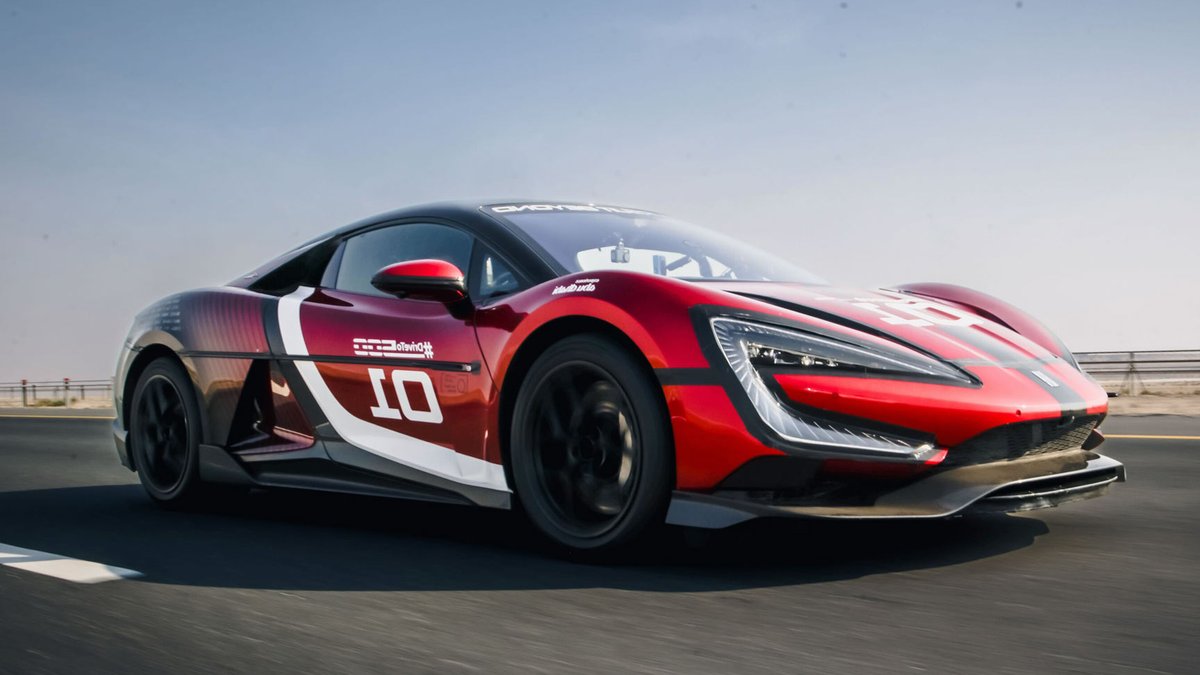
The Yangwang U9 Xtreme has now set a new speed record of 312mph during a test on the E11 highway in Abu Dhabi’s Al Dhafra region, surpassing its own previous mark. This electric hypercar, developed by BYD through its performance division, has claimed the title of the world’s fastest production vehicle—a distinction it first secured in Germany with a 308.22mph run last year. That earlier record had already established it as the fastest electric vehicle ever built, but the latest achievement in the United Arab Emirates has redefined speed benchmarks across the automotive industry.
The test occurred on a segment of the E11 highway, where local authorities temporarily closed sections of the road to accommodate the record attempt. This stretch is known for its 160km/h (100mph) speed limit in areas near the Saudi border, offering ideal conditions for high-speed testing.
Unlike most hypercars, which depend on combustion engines or hybrid systems, the U9 Xtreme operates purely on electricity. It is powered by four 30,000rpm motors, a 1,200-volt electrical system, and a lithium iron phosphate “Blade Battery”. The record-breaking version delivers 3,000 horsepower. Production of the Xtreme is limited to 30 units, though pricing details have not been released.
The driver for the Abu Dhabi run was Marc Basseng, a former FIA GT1 World Champion. After completing the run, he highlighted the benefits of electric propulsion: “Technically, something like this is not possible with a combustion engine. Thanks to the electric motor, the car is quiet, there are no load changes, and that allows me to focus even more on the track.”
Electric hypercars now dominate speed records
This achievement comes as electric hypercars increasingly challenge traditional speed records. The U9 Xtreme now outperforms competitors such as the Koenigsegg Agera RS (277mph), the Bugatti Chiron Super Sport 300 (304mph), and the Rimac Nevera R (268.2mph).
The E11’s remote location and long straightaways created optimal conditions for the test. Engineers adjusted the car’s aerodynamics and powertrain mapping to sustain speeds beyond 300mph, where air resistance becomes critical. The final 312mph figure represents an average of multiple runs, ensuring the record meets official certification standards.
Read Also: Freezing temperatures to hit UK roads
BYD has positioned the U9 Xtreme as a demonstration of its engineering capabilities. In a statement, Yangwang was described as “a brand that does not recognise the impossible”. The hypercar’s development reflects a broader industry shift, with electric performance vehicles now competing with, and surpassing, the limits of internal combustion engines.
Local authorities extended their cooperation beyond road closures. Engineers focused on refining the U9 Xtreme’s aerodynamics, optimizing the rear wing and underbody diffusers to reduce drag at sustained speeds. The car’s active aerodynamics, including adjustable front and rear wings, were recalibrated to balance downforce and stability without compromising top-speed efficiency.
Engineering tweaks unlocked 312mph stability
Engineers monitored tire temperatures and pressures in real time, ensuring they stayed within operational limits. The braking system, equipped with carbon-ceramic discs and a high-capacity cooling system, was also tested to its limits during deceleration from record speeds.
The U9 Xtreme’s powertrain mapping was recalibrated to prioritize sustained high-speed stability over raw acceleration. Engineers introduced a “speed mode” that optimized torque distribution across the four motors, reducing wheelspin. Data loggers confirmed the 1,200-volt electrical system operated safely, with battery temperatures remaining below 80°C (176°F). The Blade Battery’s lithium iron phosphate chemistry prevented overheating, a common issue in high-performance electric vehicles.
The record attempt also highlighted the challenges of certifying top-speed claims in the hypercar sector. Unlike acceleration records, which can be measured over short distances, top-speed runs require multiple back-and-forth passes to calculate an average. The final certified average of 312mph was derived from consistent runs, ensuring compliance with FIA and Guinness World Records standards. Onboard telemetry, cross-referenced with radar and GPS data from local authorities, further validated the result.


