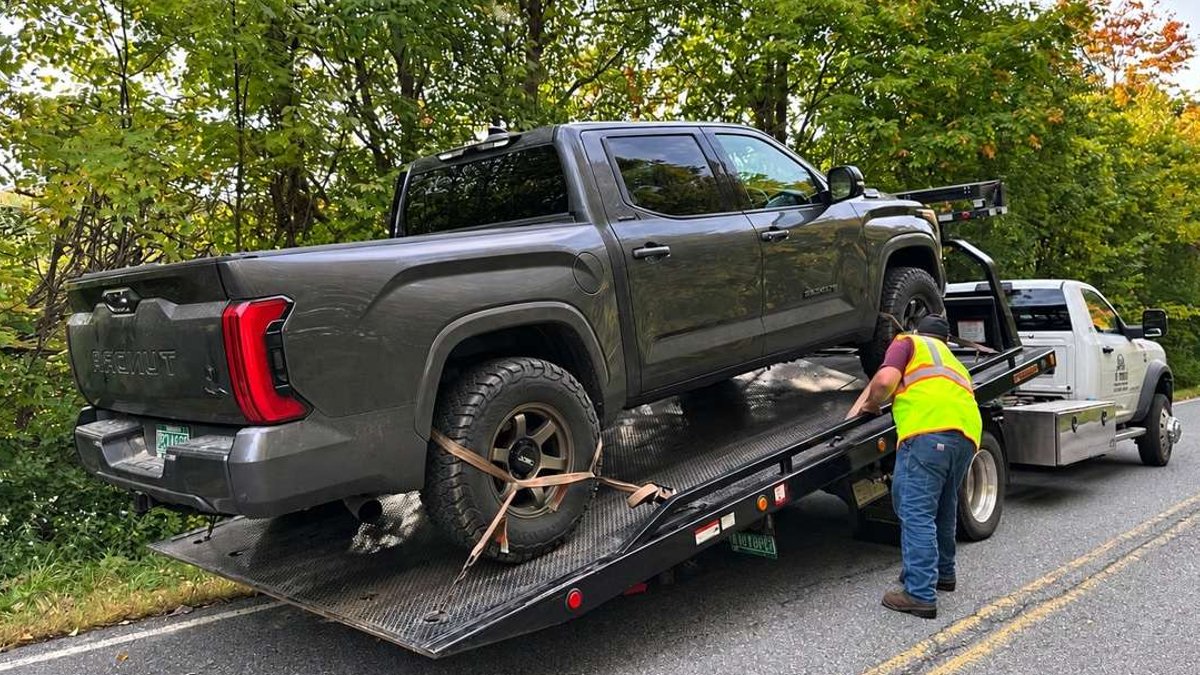
A 2023 Toyota Tundra Hybrid Limited with just 32,000 miles on the odometer suffered a blown engine, according to a post shared by owner Kyle Conant in a private Facebook group for Tundra owners. His message was brief: “Welp, it happened! Thankfully it’s under warranty.”
The timing of the failure is notable because the truck uses Toyota’s i-FORCE MAX hybrid powertrain, which has been excluded from the manufacturer’s major engine recall efforts. Those recalls, announced in May 2024, targeted certain 2022–2023 Tundras and Lexus LX 600 models equipped with the conventional gasoline-powered V35A engine. According to NHTSA documentation (recall 24V-38), machining debris left inside some engines during manufacturing could contaminate engine oil and damage main bearings, leading to knocking, rough operation, or complete loss of power.
Although the hybrid variant shares an underlying engine architecture with the recalled models, Toyota has not included it in those specific defect campaigns. The company says the configurations are not identical, and recall decisions are based on particular defects and associated safety risks. That means a hybrid engine failure does not automatically indicate the same problem affecting non-hybrid trucks.
Hydro System Warnings Don’t Always Point to Hybrid Components
Conant mentioned a “Hybrid System Failure” warning before the engine gave out. Modern hybrid systems depend on communication between the gasoline engine, electric motor, battery, and multiple control modules. Any malfunction can trigger a broad powertrain warning without specifying the exact faulty part. A mechanical engine issue could also set off hybrid-related alerts, making it difficult to trace the root cause without diagnostic codes or dealer findings.
This isn’t the first time a hybrid-powered Tundra has experienced a serious engine failure at low mileage. Earlier this year, a 2025 Tundra TRD Pro owner reported a major engine failure after fewer than 19,000 miles and only 10 months on the road. While two reported failures aren’t enough to confirm a pattern, they do keep reliability concerns front of mind for hybrid Tundra drivers.
Owners of older Tundras have taken notice. One commenter, Mitch Gould, wrote: “This is why my 2019 5.7L is still with me. It’s a shame Toyota went away from that motor.” His sentiment echoes across forums whenever a newer twin-turbocharged model suffers a major issue. Many longtime drivers say they prefer sticking with the V8 they know, especially after seeing reports of engines failing around the 50,000-mile mark.
Still, Toyota has shown willingness to go beyond standard warranty terms in some cases. Brian Geaghan, a retired general sales manager from a Toyota dealership in Maine, noted in the group discussion: “Toyota is the last company to worry about the warranty length with this kind of issue. I’ve seen them take care of customers who were 40,000 miles or more out of warranty.” He added that dealer responsiveness often shapes how owners remember a breakdown.
That support can make a real difference. One recent case involved a 2024 Tundra owner whose engine failed at 43,000 miles. The dealership provided a 2026 Tacoma TRD Off-Road as a long-term rental while working through the replacement process. Though the truck still suffered a major failure, the proactive loaner program helped ease frustration during the repair window.
For now, Conant’s repair is covered under warranty, which removes immediate financial risk. But questions remain about what caused the hybrid system warning and whether the failure ties back to known engine defects.
Diagnosis Details Remain Hidden Behind Warranty Walls
Conant’s case highlights how difficult it is for owners and observers to learn what actually broke inside a modern hybrid powertrain. Without access to diagnostic trouble codes or dealer teardown reports, the public only knows the hybrid system warning lit up before the engine failed completely.
That absence leaves hybrid owners guessing whether their trucks share vulnerabilities with the recalled V35A units or face entirely separate risks.
Dealers typically handle these repairs under warranty, which keeps paperwork confidential. Service departments rarely publish failure analyses, so patterns can stay buried until enough owners speak up independently.
Owner Communities Keep Tracking Failures Beyond Official Recalls
Private Facebook groups and online forums have become informal databases where Tundra drivers swap stories about unexpected breakdowns. Members often post photos of oil samples, failed bearings, and repair invoices to help others identify warning signs early.
Moderators in these spaces encourage users to document mileage, driving conditions, and any prior warning lights. Some trackers attempt to map failure clusters by region and model year, though nothing approaches the scale of NHTSA’s database.
These grassroots efforts fill gaps left by official channels. While Toyota focuses on known defects tied to machining debris, community-driven logs suggest other wear points may emerge over time in both hybrid and non-hybrid variants.


