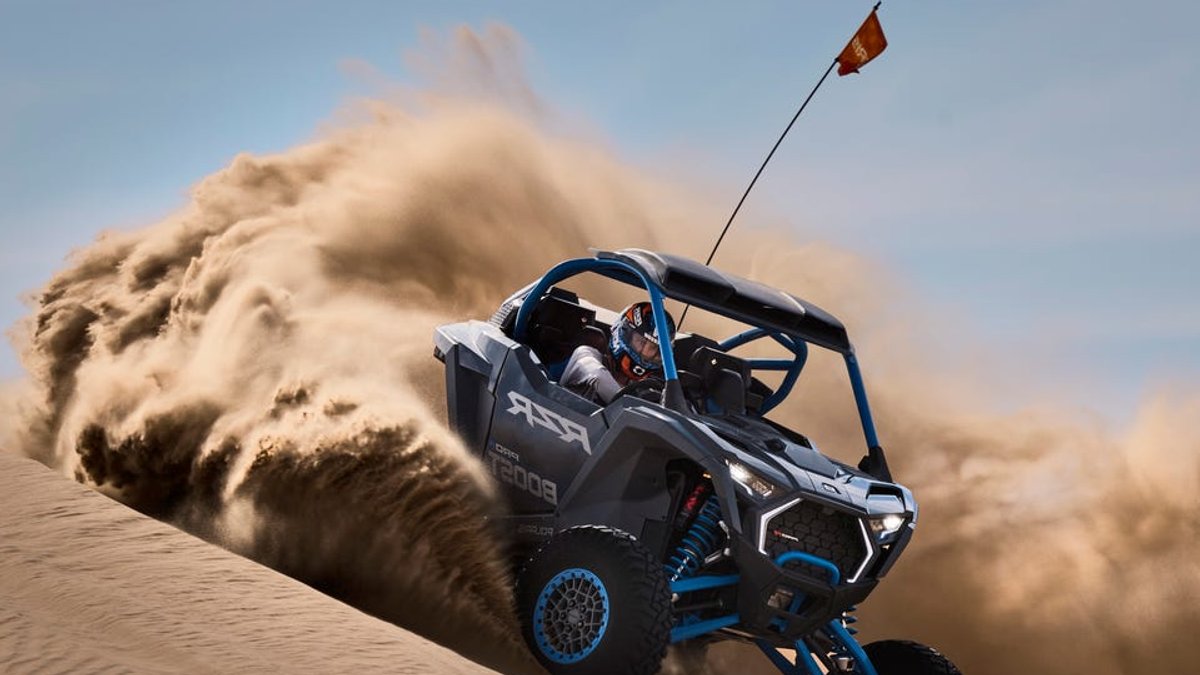
The 2027 Polaris RZR Pro R Boost will be the most powerful production side-by-side vehicle available when it reaches dealerships in November, according to the company.
The new model’s turbocharged 2.0-liter inline-four engine generates 275 horsepower and 223 pound-feet of torque, outperforming rivals like the Can-Am Maverick R and Kawasaki Teryx H2.
Power and cooling upgrades
This version enhances the naturally aspirated Pro R’s 225-horsepower 2.0-liter engine with a 66-millimeter Garrett turbocharger and a liquid-to-air intercooler. Polaris states the engine will maintain full performance until temperatures exceed 115°F or at elevations above 10,000 feet.
To manage the increased output, most drivetrain parts have been strengthened. The continuously variable transmission now features larger clutches with additional cooling fins, while the driven clutch pairs with a reinforced belt. Upgrades to the half-shafts and front differential remove previous torque restrictions to the front axle.
A redesigned cooling system includes a radiator positioned behind the occupants, supplied by a roof-mounted scoop. Though the vehicle weighs about 200 pounds more than the base Pro R, the added power still improves its power-to-weight ratio.
Related: Rare McLaren F1 sells for record price
Pricing and availability
The Pro R Boost will begin at $49,999 for the two-seat Ultimate trim. The four-seat version starts at $53,999. The Ultra trim adds active anti-roll bars, adaptive dampers, a carbon-fiber hood and seat bezel, and 32-inch BFGoodrich tires, with prices starting at $52,999 for the two-seat model and $56,999 for the four-seat variant.
Off-road enthusiasts may find the Pro R Boost’s powerband appealing, as it delivers peak torque at just 6,000 rpm and crosses 200 pound-feet as low as 3,300 rpm. This could make it more responsive in technical terrain than competitors that depend on higher-revving engines. Real-world performance will hinge on how effectively the chassis and suspension handle the additional power.
The weight increase, while significant, might be balanced by the broader torque curve. Polaris has not altered the Pro R Boost’s suspension geometry or wheelbase, indicating confidence in its current platform to support the new engine. The Ultra trim’s adaptive dampers and anti-roll bars may help, though buyers at this price level might expect more substantial improvements.
Deliveries begin in November, but Polaris has not disclosed inventory timelines or whether demand will exceed supply.


