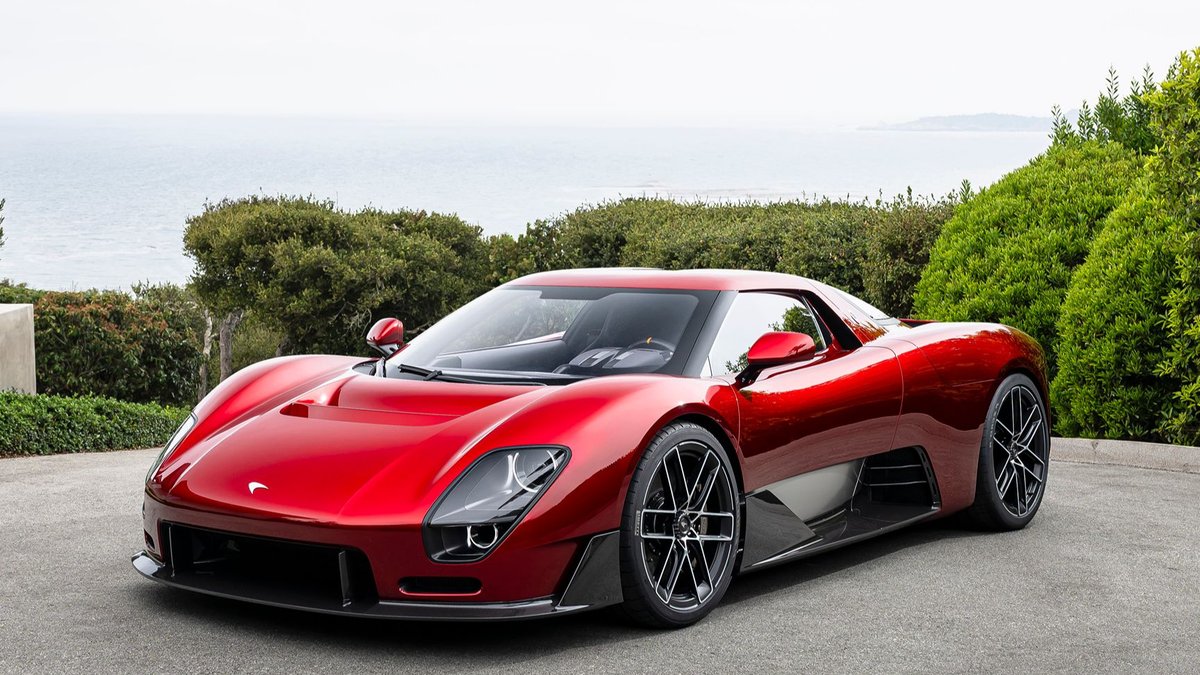
Kemal Curic has a mission: to reinvent McLaren and return the British brand to the supercar top table. The McL 6GT, a retro concept that debuted at Monterey Car Week, signals this shift. The car prompted McLaren to announce production of 500 customer units, with deliveries expected in 2028. Curic, the company’s Chief Design Officer, is guiding this new era from a recently opened studio in Bicester, Oxfordshire.
Reclaiming the brand’s history
McLaren Automotive entered the industry 16 years ago with the MP4-12C, which challenged Ferrari directly. They followed that with the hybrid P1 and a series of Longtail models before releasing the 720S, a widely praised design. However, recent years have seen the brand’s core lineup showing signs of age. Production of the 750S recently ended, and the Artura and GTS models may be phased out soon.
The company’s recovery strategy includes a £500 million investment from Abu Dhabi’s CYVN Holdings. This capital aims to create 1,000 new jobs over six years. The plan involves upgrading facilities in Surrey and Sheffield, and constructing a new factory at an undisclosed UK location. A replacement for the 750S, the McL 820, is scheduled to arrive in 2027, while an SUV is also on the horizon.
Curic and his design director, John Paul Gregory, state that the McL 6GT reflects what Bruce McLaren would drive today. The car reimagines the M6GT, a plan Bruce McLaren developed in the late 1960s. He intended to build a road-going supercar based on the M6A Can-Am racer, featuring a fibreglass body, butterfly doors, and a powerful mid-mounted Chevrolet V8. Only three prototypes were built, and Bruce McLaren died in 1970 before the project could reach production.
Read Also: Electric hypercar tops 312mph record in UAE
McLaren Special Operations (MSO) recently restored one of those original prototypes for display at the Goodwood Festival of Speed. The restored vehicle is now on permanent view at the McLaren Technology Centre. Curic noted that they did not want to build a carbon copy. Every design element had to earn its place on the new car.
The styling of the McL 6GT is simpler and more classically beautiful. The car features a simplified badge and a wordmark inspired by a sign at the McLaren family’s New Zealand service station. Details like the air intakes beneath the headlights and the tail lights draw direct inspiration from the M6GT and the McLaren F1.
The McL 6GT’s design process incorporated advanced technology, including a full-size clay model and augmented reality. The clay model, painted in a subtle grey shade, showcases the car’s sleek lines and attention to detail, such as air intakes beneath the headlights and the ‘speedy kiwi’ logo on the fuel filler. This model, with its opaque ‘windows’, serves as a tangible representation of the car’s design.
Augmented reality takes the design experience further, allowing users to explore the McL 6GT in a virtual 3D space. Wearing Apple Vision Pro goggles, one can interact with a millimetre-perfect rendering of the car, walking around it and even passing a hand through its virtual body. This technology enables designers to communicate their ideas effectively, especially with remote colleagues, and provides a unique way to experience the car’s design before its physical production.


