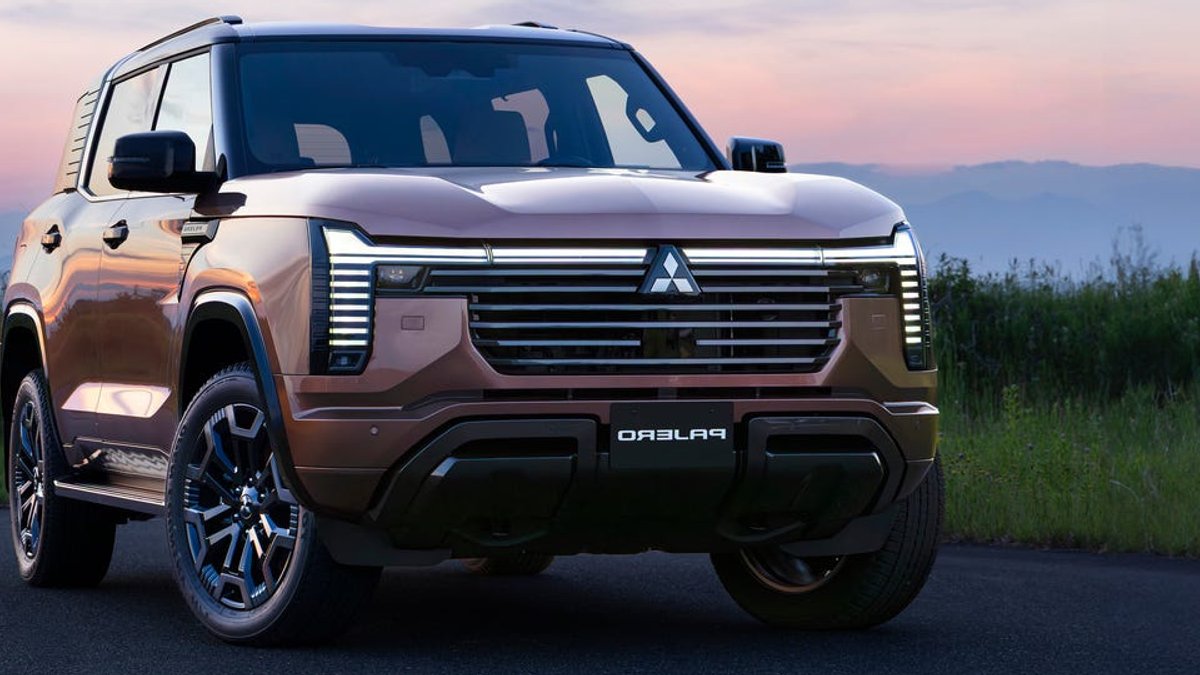
The last time Mitsubishi built a new body-on-frame SUV was 20 years ago. The last time it sold one anywhere in the world was five years ago. That gap ends this week with the unveiling of the new Pajero, a three-row flagship designed to compete with the Toyota Land Cruiser and Nissan Patrol on global markets. U.S. buyers will have to wait to learn if the vehicle will reach American dealerships.
Built like a classic, styled like a modern flagship
The new Pajero retains the traditional body-on-frame construction Mitsubishi abandoned in most of its lineup. It uses a fresh ladder frame, an independent front suspension, and a solid rear axle with five-link support. This setup matches the hardware under the Nissan Armada and Lexus LX, the closest rivals in size and capability.
Designers took advantage of the opportunity to move beyond the compact crossovers that dominate Mitsubishi’s current lineup. The result is a bold, angular shape unlike the Eclipse Cross or Outlander sold in the U.S. today. A full-width H-shaped LED headlight bar wraps around the front, while a matching graphic on the rear is split by large “Pajero” lettering. Wide fenders and sharp creases give the SUV a strong presence, closer to a luxury off-roader than a typical family vehicle.
The interior contrasts with the rugged exterior. A double-screen infotainment system spans most of the dash, surrounded by a few physical buttons. Brown and black two-tone leather covers the seats, door panels, and dashboard, creating a warmer, more upscale feel. The cabin balances toughness with comfort, built for rough terrain but designed for refinement.
No Ralliart version yet, but a hybrid is coming
Mitsubishi has no immediate plans to bring back the Ralliart performance brand for the Pajero, though a concept version appeared at the unveiling. A hybrid variant is in development, though details remain limited. That powertrain would likely arrive before any high-performance version, if one ever does.
Related: Jeff Gordon sweeps historic IROC races in DC
The Pajero’s return signals Mitsubishi’s intent to reclaim its position as a global flagship. The automaker hasn’t had a true contender in this segment since the last Montero left U.S. showrooms in 2006. The new model’s design and engineering show the company wants to compete again—but only if markets like the U.S. still demand a traditional, body-on-frame SUV.
Those chances appear low for now. Mitsubishi has not confirmed plans to bring the Pajero to North America, and if it does, the vehicle would likely be sold as the Montero, the name used in the U.S. before discontinuing the model. The company has also teased two Pajero-inspired crossovers, but those are expected to be unibody vehicles closer to the Ford Bronco Sport than the full-size Pajero. American buyers will have to rely on renderings and speculation for now.
The Pajero arrives at a time when Mitsubishi’s U.S. lineup is dominated by crossovers like the Outlander and Outlander Sport. Its success will depend on whether enough buyers still want a truck-based SUV—or if the formula is no longer viable.
The SUV goes on sale in select global markets later this year. No announcement has been made about a potential Montero badge for the U.S.


